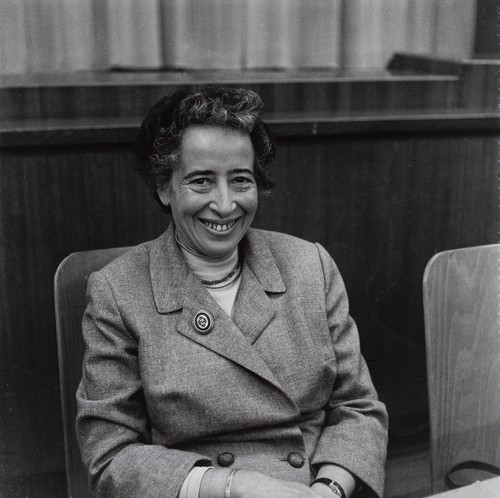
Early Life and Education: Hannah Arendt was born on October 14, 1906, in Linden, a suburb of Hanover, Germany. Growing up in a secular Jewish family, she was exposed to diverse philosophical and political ideas from an early age. Arendt pursued her education at the University of Marburg, where she studied philosophy under the influential thinker Martin Heidegger, and later continued her studies in Berlin. Her academic journey was marked by an exploration of existentialism, totalitarianism, and the nature of power, themes that would dominate her later work.
Intellectual Contributions: Arendt's intellectual career flourished in the mid-20th century, particularly with her groundbreaking works, including "The Human Condition" and "Eichmann in Jerusalem." In "The Human Condition," she examined the active life and the interplay of labor, work, and action in the human experience. Arendt's controversial report on the trial of Adolf Eichmann introduced the notion of the "banality of evil," suggesting that ordinary individuals could commit heinous acts without deep ideological motivation. This concept has sparked extensive discussion in both philosophical and political circles, solidifying her reputation as a critical thinker.
Legacy and Influence: Hannah Arendt's insights into totalitarianism, authority, and the nature of evil continue to resonate in contemporary discourse on politics and ethics. Her ability to distill complex ideas into accessible prose made her works a staple in political theory and philosophy courses worldwide. Arendt's unique perspective on the human condition and her insistence on the importance of individual thought and action have inspired generations of activists, scholars, and readers alike.
Final Years and Death: In her later years, Arendt became a prominent public intellectual, contributing to various publications and engaging with pressing social issues of her time. She passed away on December 4, 1975, in New York City, leaving behind a rich legacy of thought that challenges us to confront the moral complexities of our world. Hannah Arendt's work remains as relevant today as it was during her lifetime, urging us to reflect critically on our roles within society and the nature of power itself.